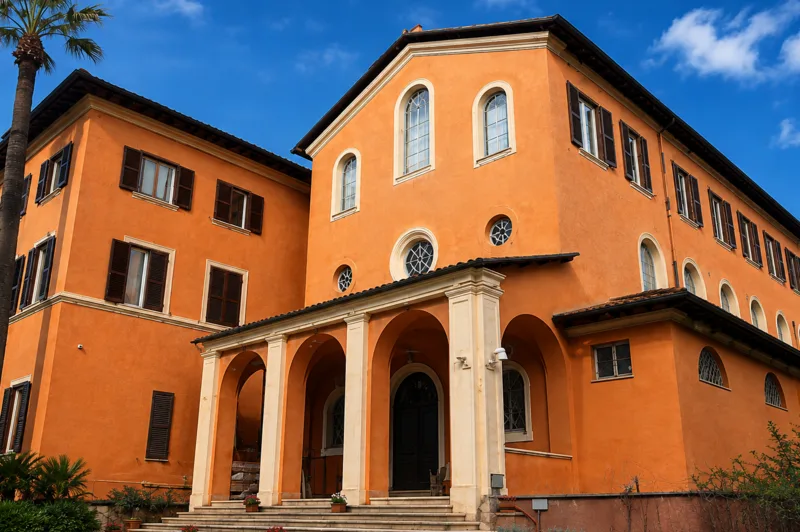
St. Stephen's School Rome: an American high school on the Aventine
St. Stephen's School was founded in 1964 as an independent American high school in Rome, and it still does something no other school in the city does: it takes students for the last four years of school only, grades 9 to 12, as day students or as boarders, on a campus on the Aventine Hill a few minutes from the Circus Maximus and the Baths of Caracalla. The student body is deliberately small and comes from dozens of countries, which is why the school can run seminar-sized classes and why the city itself is treated as part of the curriculum: the Classics tradition at St. Stephen's is unusually strong, and lessons in art, history and archaeology genuinely happen in Rome rather than about Rome. For a family, the practical consequence is that a student arrives at fourteen or fifteen into a four-year programme that is already pointing at university applications, with very little time to discover late that the Maths foundations from a previous school do not line up.
The programme: American diploma and IB Diploma together
Students work towards the American High School Diploma, with the IB Diploma available over grades 11 and 12 for those who want it, so a single class group can contain a student building a GPA and transcript for a US application and a student sitting IB Mathematics Analysis and Approaches or Applications and Interpretation, Higher or Standard Level, in May of grade 12. In practice that means two different clocks running at once. The American side is continuous assessment: homework, quizzes, tests and participation feed a semester grade that lands on the transcript and never comes off. The IB side is terminal: an Internal Assessment in each science and in Mathematics, and final papers in May that carry the majority of the marks. A student can be doing well on one clock and badly on the other, and the two failure modes look nothing alike. Physics adds a third layer, because IB Physics Higher Level asks for algebraic reasoning that the maths course has often not covered yet at the moment the physics topic arrives.
Where the marks are actually lost
Three places, in my experience with this kind of programme. First, the jump into grade 11: a student who arrived from a school with a lighter Maths syllabus meets calculus and functions at IB pace, and the gap is not intelligence but missing algebra, logarithms and trigonometry from two years earlier. Second, the Internal Assessment. It is twenty per cent of the Maths grade and it is marked against published criteria, not against how interesting the idea is; most of the marks that go missing are marks for reflection, for justified mathematical processes and for correct notation, all of which are recoverable if the exploration is planned properly before it is written. Third, the final papers: IB Physics and IB Maths are marked by method, so an answer with the right number and no visible working scores less than a wrong final answer with correct, legible reasoning. Students trained in a continuous-assessment culture often write for the teacher who knows them, not for an examiner in another country who does not.
How tutoring works for St. Stephen's students
Lessons are one to one and online, on a shared whiteboard, which for a school on the Aventine matters more than it sounds: nobody crosses Rome at six in the evening, boarders can book from campus, and a family that spends the summer abroad keeps the same slot. We start from the student's own material, the school's tests, the IB syllabus for their exact course and level, and past papers with their mark schemes, and the first session is an assessment session: I want to see what the errors have in common before deciding anything. Everything written during the lesson is sent afterwards as notes, so nothing depends on what a tired student managed to copy at nine in the evening. Parents get a short summary of what we worked on and what comes next. There is one tutor, me, with a PhD in Physics and more than ten years teaching international-school students: no rotation, no first lesson spent explaining the situation again.
From the Aventine to university
St. Stephen's students apply in several directions at once: US universities on transcript, GPA, essays and often SAT, UK universities through UCAS on predicted IB grades, and European or Italian universities where the IB Diploma is recognised and the score in Maths and Physics decides admission to engineering, medicine and the sciences. All of those routes are settled before the final exams, because they run on predicted grades and on the marks already in the file. That is why the useful moment to fix Maths and Physics is grade 10 or the start of grade 11, not April of the final year, and why the mocks matter more than they look: they are the evidence a teacher uses when writing the prediction. If the target is a course with a hard quantitative gate, an engineering degree, a physics degree, a medical entrance test, we work backwards from the score that gate requires and rebuild the topics that stand between the student and it.
Assessment session for St. Stephen's families: twenty minutes on the student's real material, and a written answer on which topics decide the grade and in what order to fix them. No commitment.
Frequently Asked Questions
How does a lesson actually work?+
Which Maths and Physics courses do you cover?+
Can you help with the Internal Assessment or the Extended Essay?+
In which language are the lessons?+
Related Articles
How to Write an IB Internal Assessment | Step-by-Step Guide (2026)
The complete guide to planning, writing and scoring high on your IB IA. Includes topic selection tips, structure templates, and common mistakes to avoid.
IB Physics HL vs SL: Which Is Harder, and Which Do Universities Want?
Not sure whether to take IB Physics at Higher or Standard Level? A clear comparison of difficulty, syllabus content, university requirements, and study tips.
IB Score for Top Universities 2026: 38 UK, 40+ Oxbridge
A data-led overview of the IB Diploma scores typically requested by Bocconi, Politecnico, Oxford, Cambridge, Ivy League and ETH, with required HL subjects and predicted-grade mechanics for 2026 applicants.