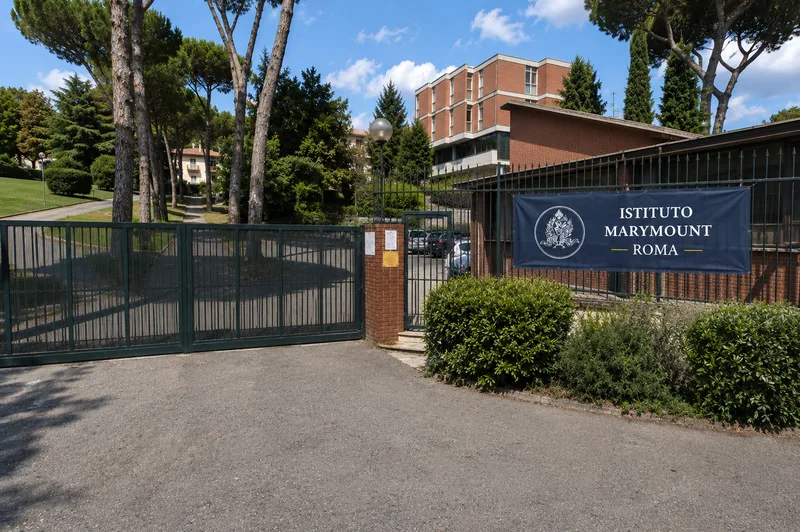
Marymount International School Rome: a Marymount school since 1946
Marymount International School Rome was founded in 1946 by the Religious of the Sacred Heart of Mary, the congregation behind the Marymount schools in New York, Paris, London, Barcelona and elsewhere, and it belongs to that international family rather than being a one-off international school in Italy. It sits on a large green campus in the Cassia and Vigna Clara area of northern Rome, teaches in English, and is Catholic in a way that shows in the pastoral structure and the service programme more than in the syllabus of a physics lesson. Its community is heavily international, with a steady turnover of families posted to Rome for a few years, and a solid core of Roman families who stay for the whole school. For a parent comparing schools, the useful thing to know is that Marymount is an American-structured school with a Diploma at the end, and that structure is what determines how a grade is built and how it can be repaired.
How the years are built: continuous assessment, then the IB Diploma
Through middle school and the first years of high school the assessment is American in style and continuous: quizzes, tests, projects, homework and participation combine into a grade for each semester, and those grades accumulate into a transcript that universities read. Then the last two years bring the IB Diploma, with six subjects, three of them Higher Level, Theory of Knowledge, the Extended Essay and CAS, and in the sciences an Internal Assessment worth twenty per cent alongside terminal papers in May. In Mathematics that is Analysis and Approaches or Applications and Interpretation; in Physics it is Higher or Standard Level with the same IA structure. The shift between the two systems is real and it is not announced. For eight years a student is rewarded for steady work handed in on time; in the Diploma years, a single set of papers in May carries most of the grade, and revision, exam technique and pacing become subjects in their own right that nobody has formally taught.
Where Maths and Physics get hard here
The first pressure point is the year before the Diploma, when subject and level choices are made. A student who has always had good report cards can pick Higher Level Mathematics on the strength of those cards and then meet calculus, proof and abstract functions at a pace that has nothing to do with what earned those cards. The second is the Internal Assessment, in Maths and in Physics: it is marked against published criteria, and most lost marks are lost in reflection, in justification of the mathematical process and in notation rather than in the idea itself. The third is the physics of the final year, where a topic often needs algebra the maths course has not reached yet, so a student who is fine in both subjects separately falls between them. None of these three is a talent problem. All three are visible in advance, which is the only reason it is worth writing them down.
How tutoring works for Marymount students
One to one, online, on a shared whiteboard, with everything written during the lesson sent afterwards as notes. For a campus on the Cassia that removes the part families dislike most, a second journey across northern Rome on a school evening, and it keeps the lesson slot intact when a family travels or moves on to the next posting. The work is built on the student's own material: school tests, the IB syllabus for their exact course and level, and past papers with their mark schemes. We spend real time on how marks are awarded, because in the IB a correct answer without visible method is worth less than a wrong answer with sound reasoning, and that single fact changes how a student writes. The first session is an assessment session and it produces a written summary for the parents: what the errors have in common, what to fix first, and roughly how long it takes.
Applications: the United States, the UK and Europe from the same desk
Marymount leavers apply along all the usual international routes: US universities, which read the transcript, the GPA, the essays and often the SAT; UK universities through UCAS, which read predicted IB grades; and English-taught degrees across Europe and in Italy, which read the Diploma score and the subject grades. Since the American side of the school builds a transcript from the very first semester of high school, and since predicted grades come from mocks in the penultimate year, both of the numbers that matter are largely written before the final exams start. In practice that makes the ninth and tenth grades quietly decisive, and it makes the mock season the real deadline. Where a target course has a hard requirement, an engineering degree asking for Higher Level Mathematics, a medical route with a Physics requirement, we start from that requirement and work backwards.
Assessment session for Marymount families: twenty minutes on the student's own work, and a written answer on what decides the IB grade in Maths and Physics and where to start. No commitment.
Frequently Asked Questions
Do you cover both IB Mathematics courses?+
My child is in middle school. Is it too early for tutoring?+
Do you also prepare the SAT for US applications?+
How does a lesson actually work?+
Related Articles
How to Write an IB Internal Assessment | Step-by-Step Guide (2026)
The complete guide to planning, writing and scoring high on your IB IA. Includes topic selection tips, structure templates, and common mistakes to avoid.
From IB to University: UK, USA and Italy
How the IB Diploma prepares students for top universities and what families need to know about admissions.
IB Mathematics: Common Challenges and How to Overcome Them
From Analysis and Approaches to Applications and Interpretation: the most frequent difficulties and practical strategies to succeed.