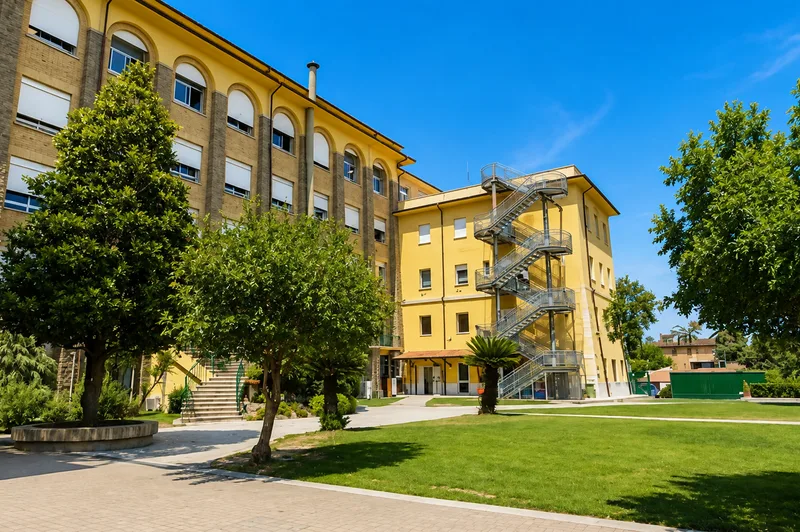
St. George's British International School: sixty years of British education in Rome
St. George's opened in 1958 and grew into the largest British international school in Rome, with its main campus in the green La Storta area to the north west of the city, along the Cassia corridor where a good part of Rome's international community lives. It teaches the English National Curriculum from the early years upwards, in English, to a community that mixes British and other expatriate families, diplomatic and corporate postings, and Italian families who want their children to finish school on an English-language qualification. The size is part of the character: a school of that scale can offer a wide subject choice, full sports and music programmes, and a sixth form with real breadth, but it also means Maths sets and Physics groups are large enough that a student who slips quietly is not always noticed in the week it happens. That is usually where an outside pair of eyes earns its place.
IGCSE first, then the IB Diploma: two exam cultures in one school
The academic spine is familiar to any British family: subject choices at the end of Year 9, two years of IGCSE courses in Years 10 and 11 with examinations in May and June, and then a sixth form that in Rome leads to the IB Diploma rather than to A-Levels. In Maths that means the Cambridge or Edexcel IGCSE at Extended tier, often with Additional Mathematics alongside it for the students heading towards sciences, followed by IB Mathematics Analysis and Approaches or Applications and Interpretation at Higher or Standard Level. In Physics it means IGCSE Physics, with its calculation papers and its practical alternative, followed by IB Physics with Internal Assessment and terminal papers. The two systems reward different habits. IGCSE rewards fluent, fast, accurate technique on predictable question types; the IB rewards explanation, modelling and command terms, and punishes the student who has learned to produce answers without saying why. Nobody warns families that the skill that earned the IGCSE grade 9 is not the skill that earns a 7 in Higher Level.
The two moments that decide the grade
The first is Year 10. IGCSE Maths and Physics are cumulative: algebra that was shaky in Year 9 does not stay a small problem, it becomes the reason simultaneous equations, rearranging formulae and the whole of the calculation paper feel impossible two years later. Most of the work I do at this stage is not new material at all, it is repairing foundations while keeping up with class, and it is far cheaper in hours than the same repair attempted in the spring of Year 11. The second is the move into the Diploma. A student choosing Analysis and Approaches Higher Level is committing to two years of calculus, proof and abstraction on top of five other subjects, the Extended Essay and CAS, and the honest question, which is best asked before the choice and not in November, is whether that level serves the university plan or only the family's pride. Where it does serve it, the answer is a plan and a schedule. Where it does not, Standard Level with a 7 beats Higher Level with a 4 on almost every application.
How tutoring works for St. George's students
One to one and online, on a shared whiteboard, with everything written during the session sent afterwards. For a school out on the Cassia this is the practical part: no second commute after a day that already includes a school bus, and a lesson time that survives exam weeks, half terms and travel. We work on the exact syllabus the student sits, Cambridge or Edexcel at IGCSE, the right IB course and level after that, using past papers and their mark schemes rather than generic exercises, because marks are awarded by mark scheme and nothing teaches that faster than reading one. The first meeting is an assessment session: I look at recent tests and homework, find what the errors have in common, and say plainly whether the problem is content, method or exam technique, which are three different repairs. Parents get a short written note after each block, so the picture at home matches the picture in the file.
Predicted grades, UCAS and what happens after Year 13
St. George's leavers apply mostly through UCAS to British universities, and increasingly to the Netherlands, to Italian degree courses taught in English and to the United States. All of those routes are decided on predicted grades, which are written months before the exams and are based on mocks and classwork, so the timeline that matters is not the exam timetable, it is the mock timetable. A conditional offer from a competitive Maths, Engineering, Economics or Medicine course typically hangs on a specific score in Higher Level Mathematics or Physics, and that is a number we can work backwards from with a topic list and a schedule. It is also worth saying what does not need fixing: a student who has a clear plan and steady grades does not need tutoring at all, and I say so at the assessment session rather than selling a package.
Assessment session for St. George's families: twenty minutes on the student's own papers, and a written answer on whether the gap is content, method or exam technique. No commitment.
Frequently Asked Questions
Which IGCSE boards and papers do you prepare?+
My child is choosing between Analysis and Approaches HL and SL. Can you advise?+
How does a lesson actually work?+
When is the right time to start?+
Related Articles
CIE 0580 vs Edexcel 4MA1: Which IGCSE Maths Board Gives the Best Shot at an A*?
An honest, parent-focused comparison of the two main IGCSE Maths boards: paper structure, grade scales, content and difficulty. The short version: the board is usually fixed by your school, and preparation matters far more than which one you sit.
IGCSE Additional Mathematics 0606: Should You Take It
What 0606 covers beyond 0580 Extended, why there is no formula sheet in the exam, and a table to decide whether the extra IGCSE is right for you.
IGCSE vs IB: Which International Curriculum Is Right for Your Child?
Comprehensive comparison of IGCSE and IB curricula for international school families. Age groups, assessment style, university recognition, and choosing the right path.