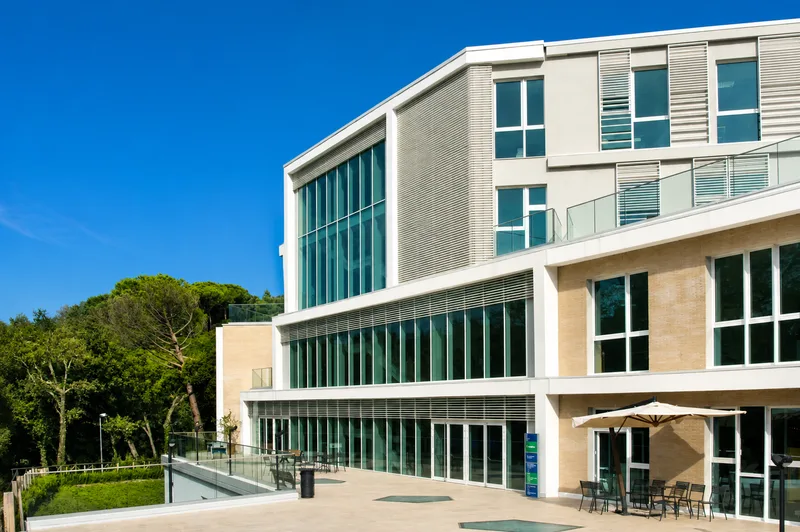
Rome International School: an English-language school in the heart of Parioli
Rome International School opened in the second half of the 1990s and sits in Parioli, on the Viale Romania side of the city near Villa Ada, which makes it the international school of central and northern Rome for families who do not want the daily run out to the Cassia. It teaches in English across the age range, ending with Cambridge IGCSE courses and then the IB Diploma, and its community is a particular mix: expatriate families posted to Rome, returning Italians whose children have been schooled abroad, and Roman families who chose an English-language education from the start and who intend to keep the Italian option open at university. That mixture shapes the classroom. In the same Maths group there are students who have never studied in Italian and students who could switch back to a liceo tomorrow, and the questions they need answered are different, which is exactly why generic tutoring works badly here and school-specific work does not.
From IGCSE to the IB Diploma: what is examined and when
The upper school runs on two internationally recognised qualifications. Cambridge IGCSE comes first, typically over two years, with Mathematics at Extended tier, often Additional Mathematics for the science-minded, and Physics with its written papers and practical alternative. The IB Diploma follows over the last two years: six subjects, three at Higher Level, plus Theory of Knowledge, the Extended Essay and CAS, with Mathematics Analysis and Approaches or Applications and Interpretation and, for many, Physics at Higher or Standard Level. In Maths and Physics the Internal Assessment is worth twenty per cent of each grade and is written during the year, while the rest is decided in the May session. The practical consequence is a compressed calendar: the IA deadlines, the mocks that produce the predicted grades and the university applications all land in the same few months of the penultimate and final year, which is when unresolved gaps from IGCSE arrive to be paid for.
The Italian question: equivalence, university at home, and the way back
Because so many RIS families are Italian or partly Italian, one question comes up that almost never comes up in Dubai or Zurich: what happens if the plan changes and the university is in Italy. The IB Diploma is recognised for admission to Italian universities through the standard equivalence procedure, so the route exists; what surprises families is the content mismatch rather than the paperwork. Italian entrance tests for engineering, medicine and the scientific faculties are built on the Italian upper-secondary syllabus, and they ask for topics, notation and speed that an IB course does not train, while assuming nothing of the modelling and explanation the IB does train. A student who moves from IB Mathematics to an Italian test paper is not weaker, they are differently prepared, and the difference is a specific, finite list of topics. The same is true in reverse for a student arriving from a liceo into Year 10 or 11 here, which is a transfer I see regularly.
How tutoring works for Rome International School students
Lessons are one to one and online, on a shared whiteboard, with the written notes sent after every session. In Parioli the reason is time rather than distance: an afternoon at RIS already ends late, and an online slot costs the family the lesson and nothing else. We work on the student's own syllabus and papers, Cambridge at IGCSE and then the exact IB course and level, and on the material the school itself sets, because the fastest diagnosis comes from a marked test, not from an interview. I teach in English or in Italian, whichever the student thinks in, and I keep the technical vocabulary in English on purpose: the exam is in English and so is the mark scheme. The first meeting is an assessment session, and it ends with a plain statement of what is wrong and in which order I would fix it, including the case where the honest answer is that little needs fixing.
After the Diploma: London, Amsterdam, Milan or Rome
RIS students spread out at the end: UK universities through UCAS, the Dutch and other English-taught European programmes, the English-language degrees at Bocconi, Politecnico or Sapienza, and a smaller number to the United States. Every one of those is decided on predicted grades and on the subject scores in Maths and Physics, months before the final papers. That means two deadlines matter more than the exam date: the mock season, because it sets the prediction, and the Internal Assessment, because it is already banked. If the target needs a 6 or a 7 in Higher Level Mathematics, we start from that number, list the topics that stand between the student and it, and put them in a calendar that fits alongside the Extended Essay rather than pretending the rest of the Diploma does not exist.
Assessment session for Rome International School families: twenty minutes on a recent test, and a written answer on which topics decide the IB grade and what to do first. No commitment.
Frequently Asked Questions
Do you teach in Italian or in English?+
Can you prepare for Italian university entrance tests as well as the IB?+
My child is moving from an Italian liceo into the IGCSE years. Is that manageable?+
How does a lesson actually work?+
Related Articles
The Real Differences Between Italian Liceo Maths and IB Math AA / AI
A topic-by-topic comparison: where Italian Liceo goes deeper, where IB goes wider, and the specific gaps a transition student needs to close.
How to Write an IB Internal Assessment | Step-by-Step Guide (2026)
The complete guide to planning, writing and scoring high on your IB IA. Includes topic selection tips, structure templates, and common mistakes to avoid.
TOLC, IMAT, SAT and UCAS: The Entrance Exam Calendar for Italian Families with International Children
A practical, evergreen guide to the four parallel application calendars Italian families with IB or A-Level children must run simultaneously: Italian universities, UK UCAS, US Common App, and the IB/A-Level exam sessions themselves.