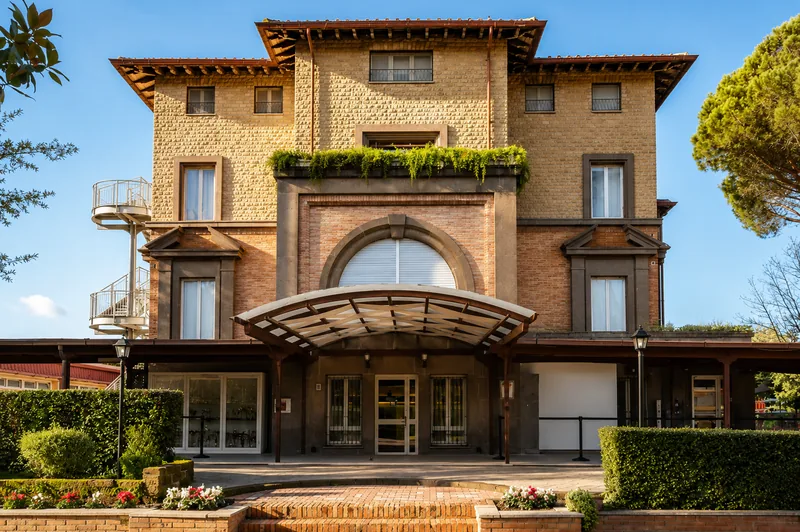
American Overseas School of Rome: the American school on the Cassia since 1946
The American Overseas School of Rome has been teaching in the city since 1946, which makes it one of the oldest American schools in Europe and, for three generations of diplomatic, corporate and Italian-American families in Rome, the default answer to the question of where to send children who may finish school on another continent. Its campus sits on the Via Cassia in the north of the city, in the belt where much of the international community lives, and it runs a United States curriculum accredited in the American system, from elementary school through to a High School Diploma. Two things follow from that history. The school is genuinely used to students arriving and leaving mid-year, from any system, and the academic structure is transparently American: credits, a GPA, a transcript, and courses that count towards graduation from the first year of high school onwards.
AP courses and the IB Diploma under one roof
What makes AOSR unusual in Rome is that the last two years can be taken in two different currencies. A student can build an American Diploma reinforced with Advanced Placement courses, sitting AP examinations in May in subjects such as Calculus AB or BC, Physics 1, Physics 2 or Physics C and Statistics, each scored from 1 to 5 and each potentially worth university credit in the United States. Or a student can take the full IB Diploma, six subjects with three at Higher Level, Theory of Knowledge, the Extended Essay, CAS, and Internal Assessments in the sciences and in Mathematics. Some students mix elements of both. The two are not simply harder and easier versions of each other: AP is a set of separate, content-heavy, single-subject exams with a large multiple-choice component, while the IB is one integrated programme assessed by extended written response and coursework. A family choosing between them is choosing not just a workload but a way of being examined, and the right answer depends on where the university applications are going.
Where students lose marks in AP and IB science
In AP Calculus the usual failure is not the calculus, it is the algebra and trigonometry underneath it, plus the speed the multiple-choice section demands: a student who is accurate but slow loses marks that have nothing to do with understanding. In AP Physics, and especially Physics C, the gap is mathematical rather than physical, because the course assumes calculus that may be running in parallel rather than already finished. In IB Physics and IB Mathematics the pattern is different again: marks go missing in the Internal Assessment, where the criteria reward reflection, justified method and correct notation, and in the final papers, where an unexplained correct answer scores less than a wrong one with visible reasoning. A student who moves from the AP track to the IB track, or takes both, meets both problems at once. The good news in every case is that these are trainable habits, not fixed abilities, and they respond quickly to work done on real past papers with the real mark scheme in front of you.
How tutoring works for AOSR students
Lessons are one to one and online, on a shared whiteboard, and everything written during the session is sent afterwards. On the Cassia that is the practical answer to a long school day: the lesson costs the time of the lesson and nothing else, and the slot survives a family's transfer to another country, which in this community happens. I teach the exact course the student sits, AP Calculus AB or BC, AP Physics 1, 2 or C, IB Mathematics Analysis and Approaches or Applications and Interpretation at either level, IB Physics at either level, and SAT Maths where the application needs it. Preparation is built on released AP exams and IB past papers with their mark schemes, not on generic worksheets. The first meeting is an assessment session on the student's own recent work, and it ends with a clear statement of what is actually wrong, in what order I would fix it, and how many hours that realistically takes.
US applications, UCAS and the Italian option
An AOSR student applying to the United States is read on the transcript and the GPA built from grade 9 onwards, on the rigour of the courses chosen, on essays and recommendations, and often on SAT scores, with AP results arriving as evidence of what the student can do in a college-level subject. A student applying through UCAS is read on predicted grades instead, whether those are IB or AP based, and a student applying in Italy or elsewhere in Europe on the diploma and its recognised equivalence. All three routes have the same consequence: the decisive numbers are produced in the year before the application, not in the final term. That is why grade 10 and grade 11 are the years worth defending, and why a Maths or Physics repair started then costs a fraction of the same repair attempted in the spring of senior year.
Assessment session for AOSR families: twenty minutes on the student's real work, and a written answer on whether the gap is algebra, pace or exam technique, in AP or in IB. No commitment.
Frequently Asked Questions
Do you cover AP Physics C, which needs calculus?+
AP or IB: which should we choose?+
Can you help with the IB Internal Assessment in Physics?+
How does a lesson actually work?+
Related Articles
IB Physics HL vs SL: Which Is Harder, and Which Do Universities Want?
Not sure whether to take IB Physics at Higher or Standard Level? A clear comparison of difficulty, syllabus content, university requirements, and study tips.
How to Write an IB Internal Assessment | Step-by-Step Guide (2026)
The complete guide to planning, writing and scoring high on your IB IA. Includes topic selection tips, structure templates, and common mistakes to avoid.
IB Diploma vs A-Levels vs Maturità: A Complete Comparison for Families
A detailed comparison of the IB Diploma against the Italian Maturità, British A-Levels, French Baccalauréat and American AP system: recognition, difficulty, university access and key differences.