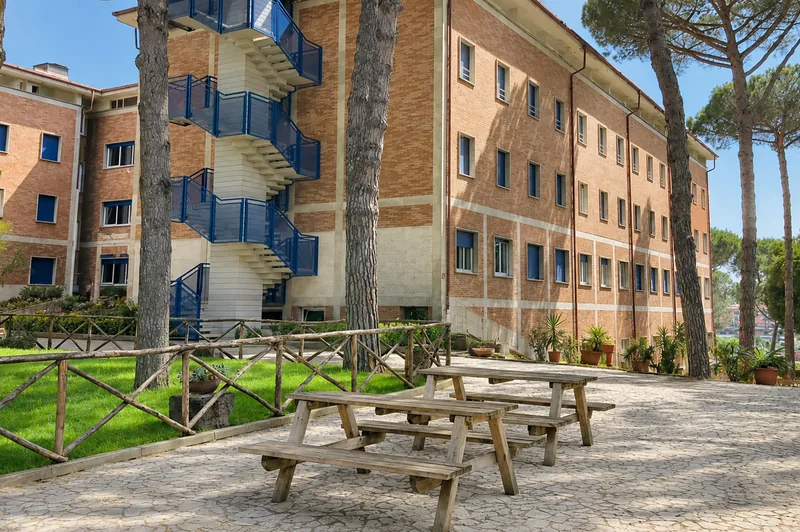
Institut Saint-Dominique: the French school in the north west of Rome
Institut Saint-Dominique is the French Catholic school of Rome, run in the Dominican tradition and set on a wooded campus in the north west of the city, in the Cassia belt. It teaches the French national programme, in French, from the youngest classes up to the terminale, and it is homologated by the French Ministry of Education, which is what makes the qualification at the end a real baccalauréat rather than a local diploma with a French flavour. Its families are a specific mixture: French expatriates posted to Rome, binational Italian and French households, and Italian families who chose the French system for its structure and for the direct access it gives to universities and grandes écoles in France. For a student, the consequence is that the school follows the French calendar, the French assessment rules and the French vocabulary of school, inside a city that runs on none of the three.
The baccalauréat as it works now: spécialités, contrôle continu and the Grand oral
Since the reform, the general baccalauréat is no longer a set of fixed streams. In première a student takes three spécialités and drops to two in terminale, and it is those two that are examined in the spring of the final year, alongside philosophie and the Grand oral, while the rest of the grade is built from contrôle continu across the two years. For a scientific profile that usually means mathématiques and physique-chimie carried through to terminale, with the option of mathématiques expertes for the strongest and mathématiques complémentaires for those who drop the spécialité but still need mathematics for their studies. The choice made at the end of seconde is therefore not a preference, it is a gate: it decides which higher-education courses are realistically open, and in France a candidate for a scientific licence, a classe préparatoire or an engineering school is read on exactly these subjects. The mathematics itself is demanding in a particular way, formal, proof-aware and written, with a strong emphasis on rédaction: the reasoning has to be composed, not just found.
Where students at a French school lose marks in maths and physics
Three places, and none of them is talent. The first is rédaction: a French maths paper gives marks for a correctly written argument, so a student who sees the answer and writes three lines loses points that a slower, more explicit classmate collects. The second is the first term of terminale, where the pace of the spécialité changes and gaps in algebra, functions and trigonometry from première stop being manageable. The third is physique-chimie, where the difficulty is usually mathematical rather than conceptual: the physics needs derivatives, equations and units handled fluently, and a student who is fighting the algebra cannot see the physics behind it. On top of these sits the Grand oral, which asks a student to defend a question drawn from the spécialités in front of a jury, and which rewards a habit almost nobody has practised: speaking mathematics and physics out loud, clearly, for several minutes, without a paper to hide behind.
How tutoring works for Saint-Dominique students
Lessons are one to one and online, on a shared whiteboard, with the written notes sent afterwards, and they run in Italian or in English, whichever the student is more comfortable thinking in. I do not teach in French, and I would rather say so plainly than let a family discover it later: what I do instead is keep the vocabulary of the French programme explicit, so that dérivée, primitive, suite, incertitude and the rest travel intact between the lesson and the classroom. In practice this works well for the many binational students at Saint-Dominique, and it works for the mathematics itself, which is the same in every language once the notation is agreed. We work on the school's own material, the annales of the épreuves, and the structure of a written answer, because in this system the way an argument is composed is worth marks in itself. The first meeting is an assessment session on real, recent work, and it produces a plain diagnosis rather than a sales pitch.
Parcoursup, and what a French bac opens in Italy and beyond
The French route runs on Parcoursup, where applications are read on the bulletins of première and terminale, on the results already banked from contrôle continu and on the spécialité subjects: in other words, on marks that exist long before the final exams. A candidate for a classe préparatoire, a scientific licence or an engineering school is judged above all on mathematics and physique-chimie, which puts those two subjects at the centre of the file. The baccalauréat is also recognised for admission to Italian universities and, being a widely understood European qualification, to English-taught degrees across Europe, so a Saint-Dominique student is not locked into France. What does not change with the destination is the timing: the marks that decide the outcome are collected in première and in the first two terms of terminale, so the work that matters is the work done before the year of the exam, not during it.
Assessment session for Saint-Dominique families: twenty minutes on a recent devoir, and a written answer on whether the marks are being lost in the mathematics or in the way it is written. No commitment.
Frequently Asked Questions
Do you teach in French?+
Which parts of the programme do you cover?+
Can you also prepare a student moving to the IB or IGCSE system?+
How does a lesson actually work?+
Related Articles
IGCSE vs IB: Which International Curriculum Is Right for Your Child?
Comprehensive comparison of IGCSE and IB curricula for international school families. Age groups, assessment style, university recognition, and choosing the right path.
The Real Differences Between Italian Liceo Maths and IB Math AA / AI
A topic-by-topic comparison: where Italian Liceo goes deeper, where IB goes wider, and the specific gaps a transition student needs to close.
From IB to University: UK, USA and Italy
How the IB Diploma prepares students for top universities and what families need to know about admissions.