Cambridge CIE · 0625 · May/June 2025
CIE 0625 Paper 4 — May/June 2025 Walkthrough
This walkthrough covers selected questions from CIE IGCSE Physics 0625 Paper 4 (Extended Theory), May/June 2025. Each question includes the original exam problem, a detailed step-by-step solution, and an exam tip to help you maximise marks on similar questions. These are the kinds of problems I work through regularly with my IGCSE students.
Resultant Force, Effects on Motion and Moments Experiment
Forces and Motion · [2] + [1] + [4]
Step-by-Step Solution
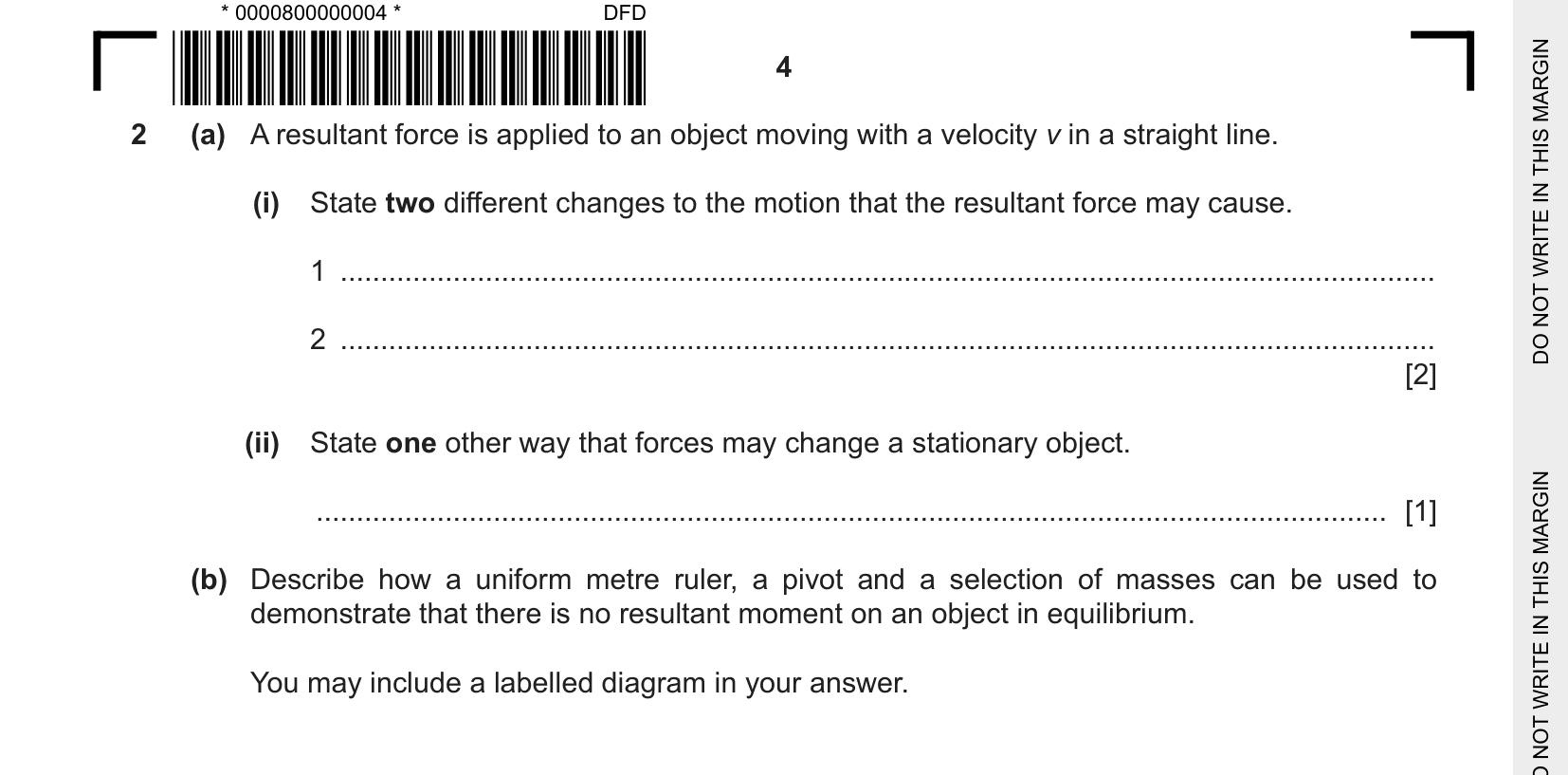
(a)(i) A resultant force on a moving object can cause two changes: 1) It can change the speed of the object (accelerate or decelerate it). 2) It can change the direction of motion. Both are valid because a resultant force causes acceleration (F = ma), and acceleration can be a change in speed, direction, or both.
(a)(ii) Forces can also change the shape of a stationary object (deform it). This is the third possible effect of a force — alongside changing speed and direction. For [1 mark], "change the shape" or "deform the object" is the expected answer.
(b) To demonstrate the principle of moments (no resultant moment on an object in equilibrium): Place the metre ruler on the pivot at its centre of mass (50 cm mark). Hang a known mass m₁ at a measured distance d₁ from the pivot on one side. Hang another mass m₂ on the opposite side and adjust its distance d₂ until the ruler balances horizontally. Record masses and distances. Verify that m₁ × d₁ = m₂ × d₂ (clockwise moment = anticlockwise moment). Repeat with different mass combinations to confirm the principle.
Exam Tip
For "describe an experiment" questions, always include: the equipment setup, what you measure, what you vary, and how you use the results. Labelled diagrams earn extra credit. Don't forget to mention balancing/equilibrium as the condition you observe.
Energy Transfers in a Skateboard Park
Energy Transfers · [3]
Step-by-Step Solution
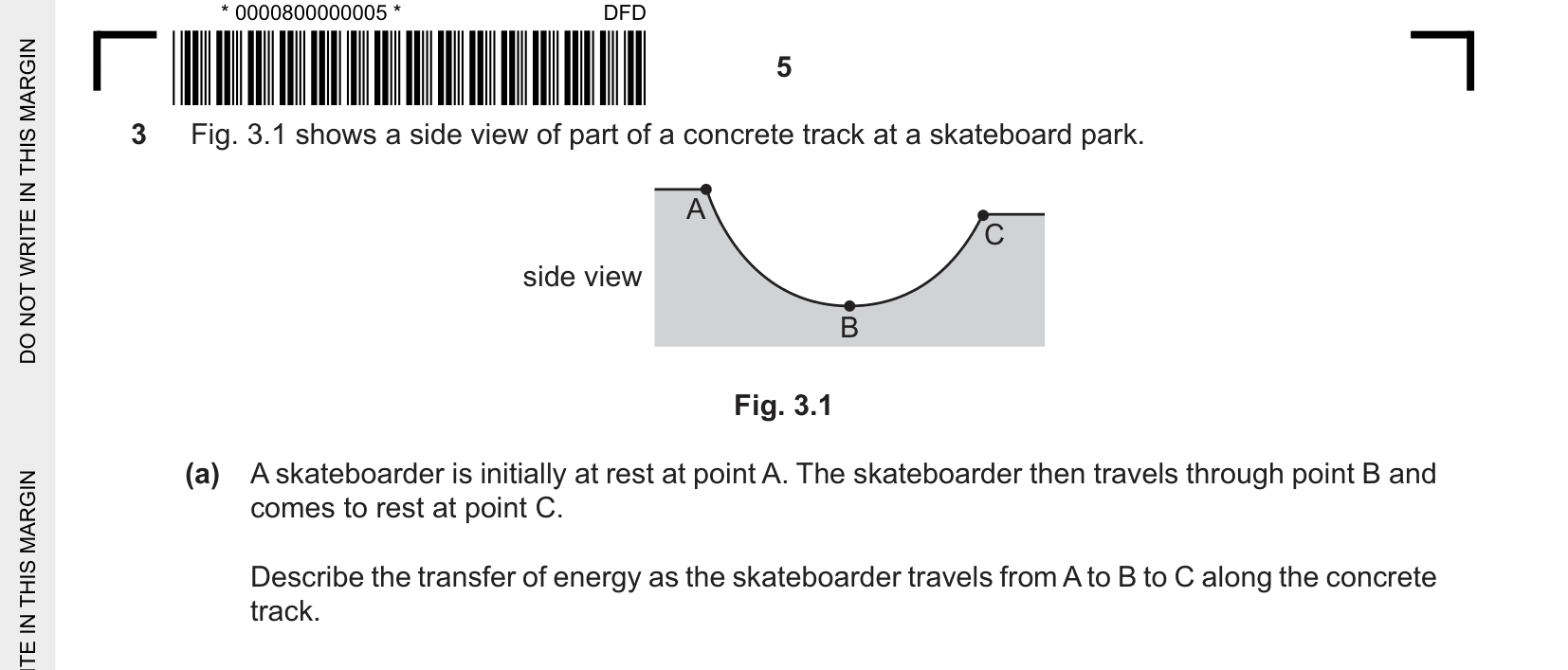
At point A (top of one side, at rest): The skateboarder has maximum gravitational potential energy (GPE) and zero kinetic energy (KE) since they are at rest.
A → B (descending to the bottom): GPE is converted to KE as the skateboarder descends. At point B (the lowest point), KE is at its maximum and GPE is at its minimum. Some energy is transferred to thermal energy (heat) due to friction with the track and air resistance.
B → C (ascending to the other side): KE is converted back to GPE as the skateboarder rises. At point C (where they come to rest), KE is zero and GPE is at a new value. Crucially, point C is lower than point A because energy has been dissipated as thermal energy due to friction. The "lost" energy means the skateboarder cannot reach the same height as A.
Exam Tip
In energy transfer questions, always mention the energy store at each key point AND the transfer mechanism between them. Don't forget friction — CIE always expects you to mention thermal energy dissipation. Explaining why C is lower than A shows deep understanding and earns full marks.
Isotopes and Beta Decay of Strontium-90
Nuclear Physics · [2] + [2]
Step-by-Step Solution
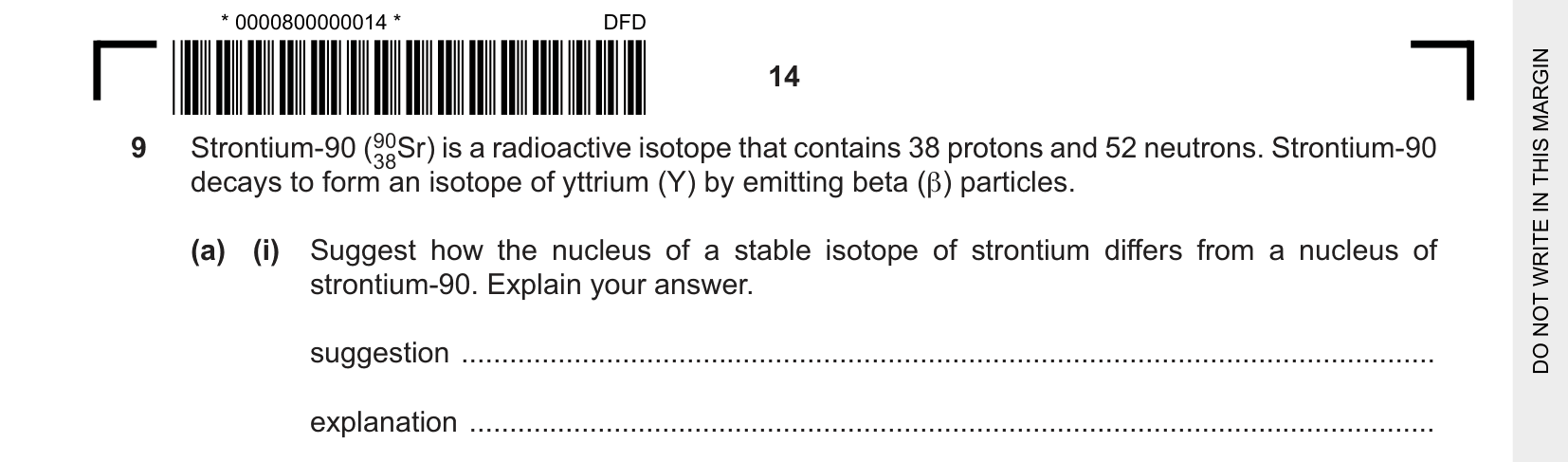
(a)(i) A stable isotope of strontium has the same number of protons (38) but a different number of neutrons. Strontium-90 has 52 neutrons (90 − 38 = 52). A stable isotope would have fewer neutrons (e.g. Strontium-88 has 50 neutrons). The explanation is that isotopes are atoms of the same element (same proton number) with different numbers of neutrons (different nucleon/mass number). The stable isotope has a neutron-to-proton ratio that does not cause radioactive decay.
(a)(ii) In beta (β) decay, a neutron converts into a proton and emits a beta particle (high-speed electron). For Strontium-90: ⁹⁰₃₈Sr → ⁹⁰₃₉Y + ⁰₋₁β. The mass number stays at 90 (nucleon number is conserved), but the proton number increases by 1 (from 38 to 39), forming yttrium (Y). This is because the emitted beta particle carries away the negative charge while the new proton remains in the nucleus.
Exam Tip
In nuclear equations, always check that both the mass numbers (top) and proton numbers (bottom) balance on both sides. For beta decay, remember: mass number stays the same, proton number goes up by 1. State the change clearly — "a neutron turns into a proton" is the key phrase examiners look for.
Planetary Composition and Gravitational Field Strength
Space Physics · [2] + [2]
Step-by-Step Solution
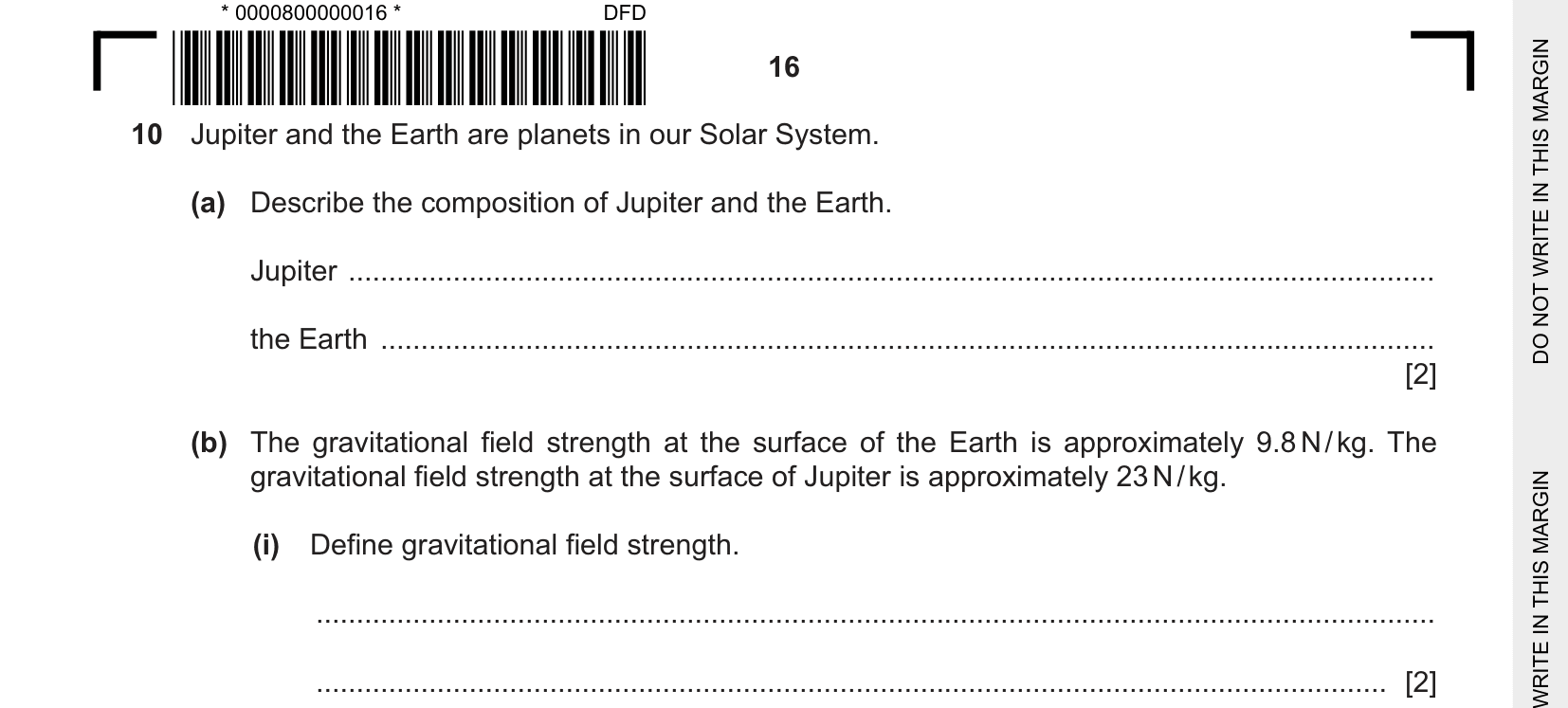
(a) Jupiter is a gas giant composed mainly of hydrogen and helium (gaseous composition, no solid surface). The Earth is a rocky/terrestrial planet composed mainly of iron and silicate rocks (with a solid surface and metallic core). Key contrast: Jupiter = gas/liquid, Earth = rock/metal. For full marks, you must name specific materials for each planet, not just say "gas" and "rock".
(b)(i) Gravitational field strength is defined as the force per unit mass acting on an object placed in the field. In equation form: g = F/m, where g is measured in N/kg. This is a standard 2-mark definition question — you need both "force" and "per unit mass" for full marks. An alternative acceptable phrasing is "the gravitational force acting on each kilogram of mass".
Exam Tip
Definition questions are free marks if you learn them precisely. For gravitational field strength, the exact wording matters: "force per unit mass" scores both marks, while "gravity on an object" scores zero. Keep a revision list of all IGCSE Physics definitions — there are about 30 key ones that come up repeatedly.
Initial assessment
Find out what is costing the marks.
Twenty minutes, one to one, online. No charge, no commitment.