Cambridge CIE · 0580 · October/November 2025
CIE 0580 Paper 4 — October/November 2025 Walkthrough
This walkthrough covers selected questions from CIE IGCSE Mathematics 0580 Paper 4 (Extended), October/November 2025. Each question includes the original exam problem, a detailed step-by-step solution, and an exam tip to help you maximise marks on similar questions. These are the kinds of problems I work through regularly with my IGCSE students.
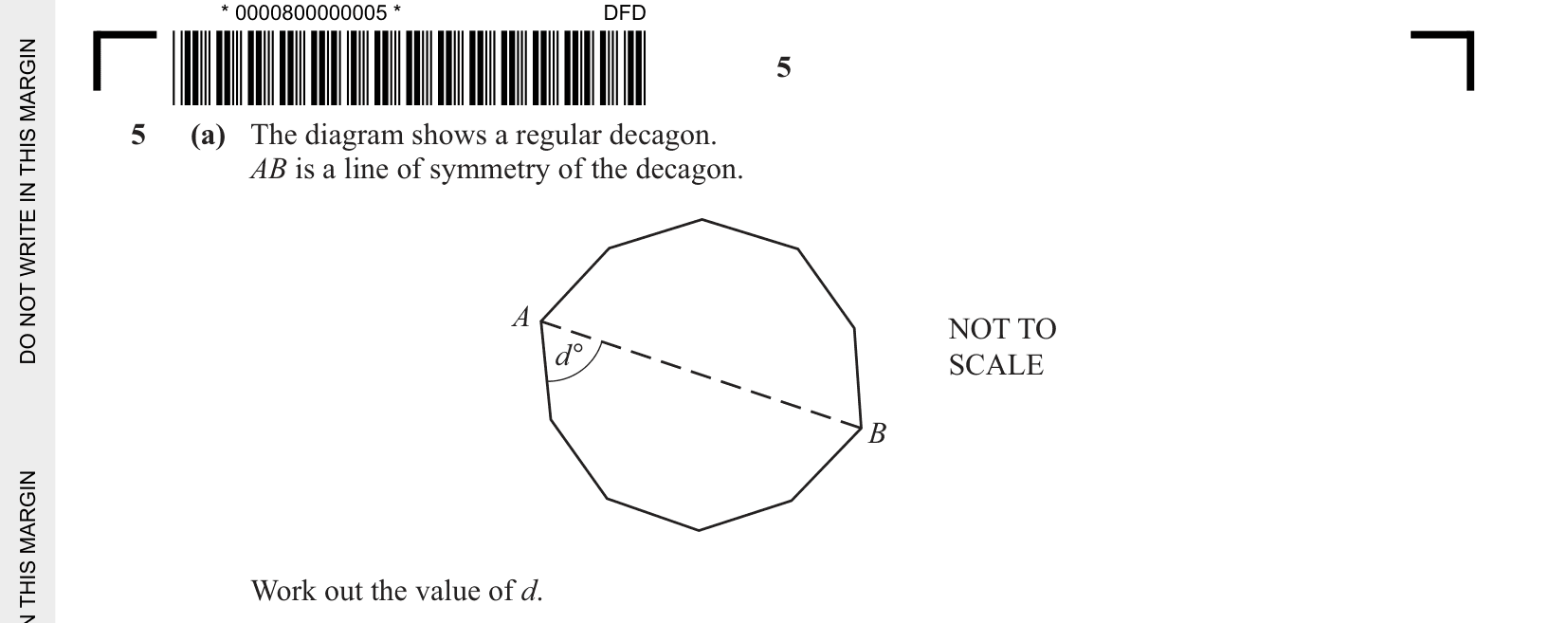
Interior Angle of a Regular Decagon with Line of Symmetry
Polygon Angles · [3]
Step-by-Step Solution
First, calculate the interior angle of a regular decagon. The formula for the interior angle of a regular n-sided polygon is (n − 2) × 180° / n. For a decagon (n = 10): interior angle = (10 − 2) × 180° / 10 = 8 × 180° / 10 = 1440° / 10 = 144°.
AB is a line of symmetry of the decagon, passing from vertex A to the opposite vertex B. Because it is a line of symmetry, it bisects the interior angle at vertex A into two equal parts.
Therefore d = 144° / 2 = 72°. The angle d is half the interior angle of the regular decagon.
Exam Tip
Always start polygon angle questions by writing the interior angle formula (n − 2) × 180° / n. Lines of symmetry in regular polygons always bisect the angles they pass through — recognising this saves time and avoids errors.
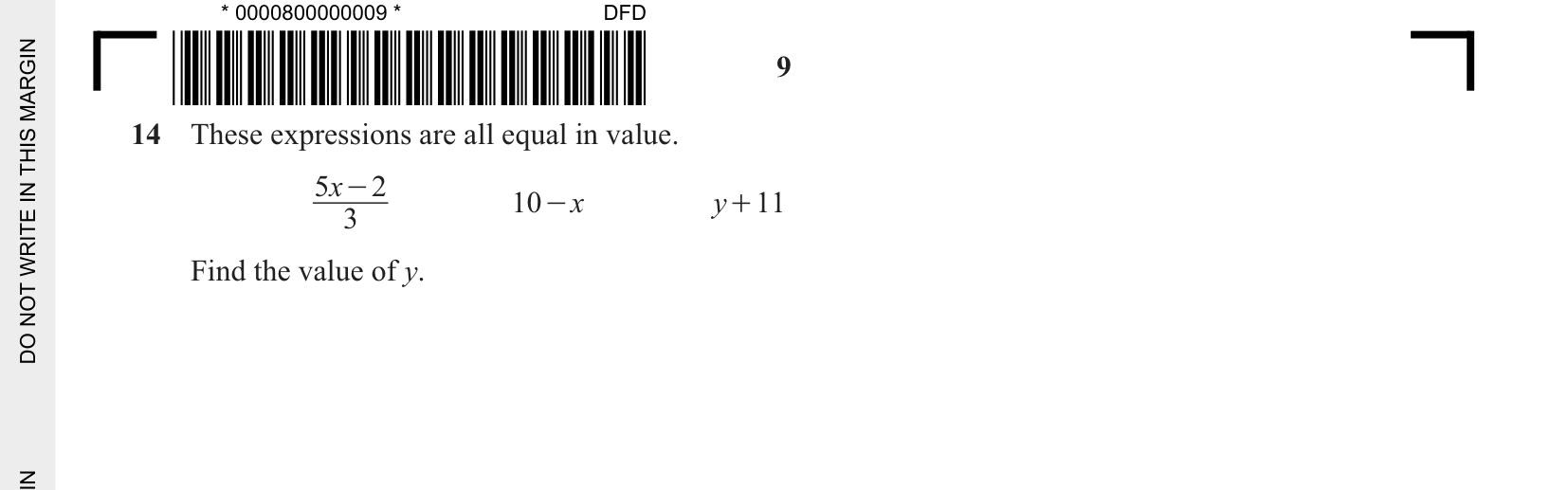
Solving Equal Expressions to Find y
Algebra — Equal Expressions · [3]
Step-by-Step Solution
We are told (5x − 2)/3 = 10 − x = y + 11. First, solve for x using the first two expressions: (5x − 2)/3 = 10 − x. Multiply both sides by 3: 5x − 2 = 3(10 − x) = 30 − 3x.
Collect x terms: 5x + 3x = 30 + 2, so 8x = 32, therefore x = 4.
Now find the common value: 10 − x = 10 − 4 = 6. Since y + 11 = 6, we get y = 6 − 11 = −5.
Exam Tip
When three expressions are set equal, pick any two to form an equation and solve for the unknown. Then substitute back to find the remaining variable. Always check your answer by verifying all three expressions give the same value.
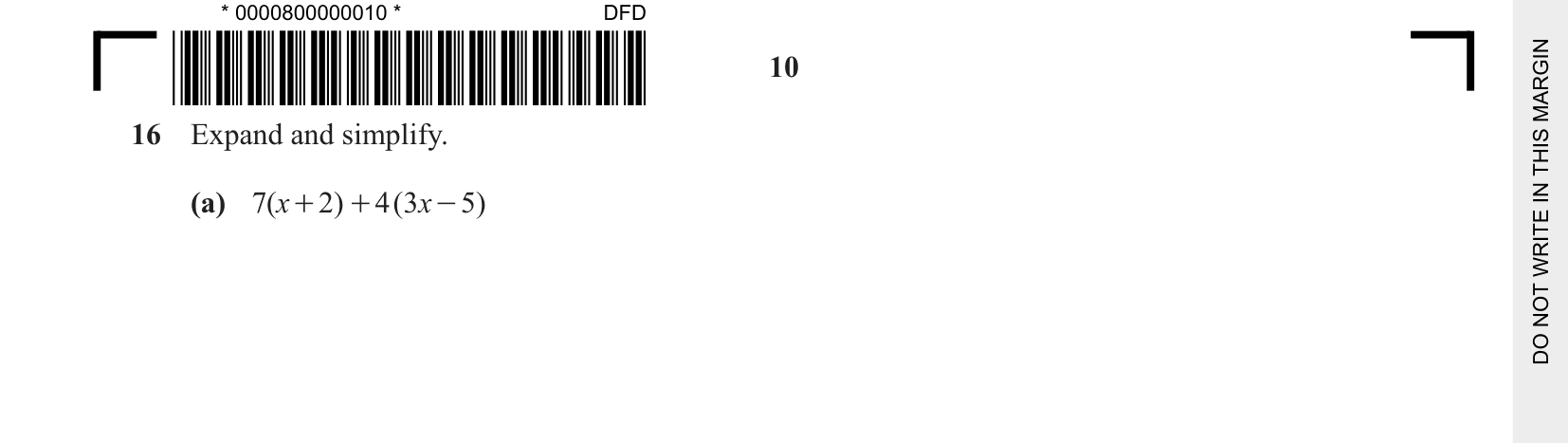
Expand and Simplify 7(x + 2) + 4(3x − 5)
Expanding Brackets · [2]
Step-by-Step Solution
Expand the first bracket: 7(x + 2) = 7x + 14. Expand the second bracket: 4(3x − 5) = 12x − 20.
Combine like terms: 7x + 14 + 12x − 20 = (7x + 12x) + (14 − 20) = 19x − 6.
Exam Tip
Take care with signs when expanding — the most common error is forgetting to multiply the sign through the bracket (e.g. 4 × (−5) = −20, not +20). Write out each expansion separately before combining to avoid mistakes.
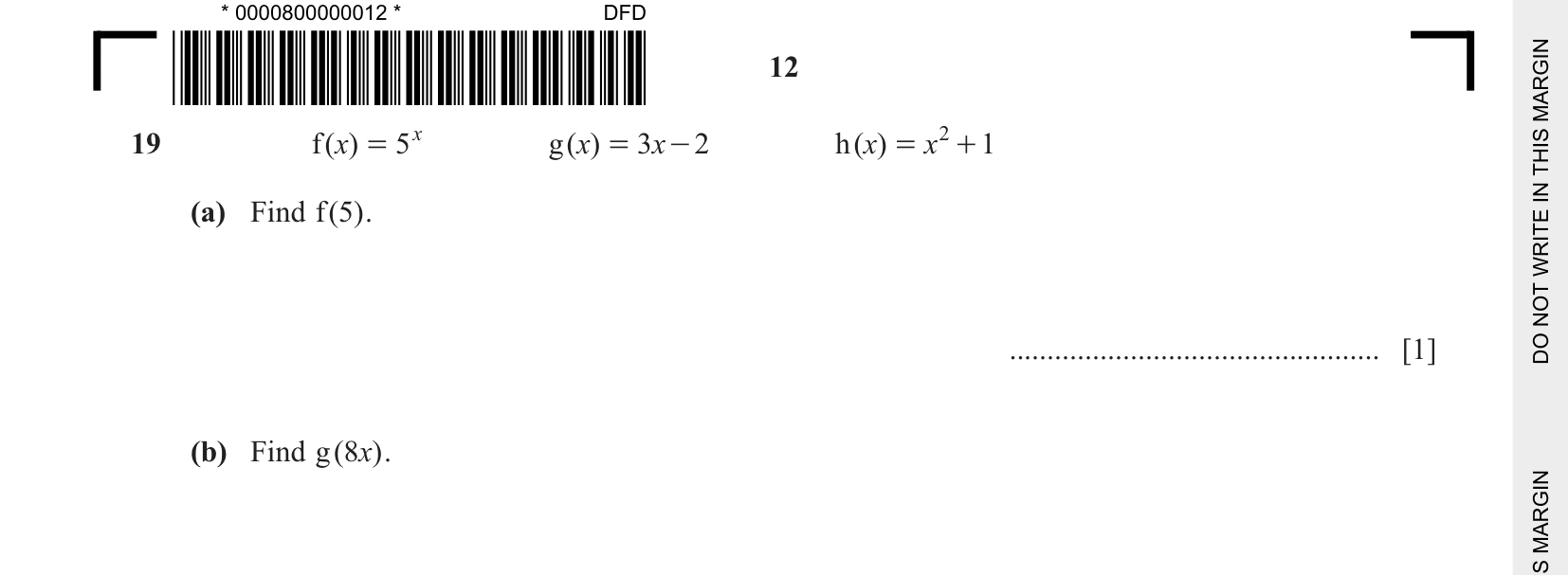
Evaluating and Composing Functions
Functions · [1] + [2]
Step-by-Step Solution
(a) f(x) = 5ˣ, so f(5) = 5⁵ = 5 × 5 × 5 × 5 × 5 = 3125.
(b) g(x) = 3x − 2, so g(8x) means replacing x with 8x: g(8x) = 3(8x) − 2 = 24x − 2.
Exam Tip
For function notation, g(8x) means "substitute 8x everywhere you see x in the formula for g". Write out the substitution step explicitly — examiners award method marks for showing the replacement clearly before simplifying.
Differentiating a Polynomial
Differentiation · [2]
Step-by-Step Solution
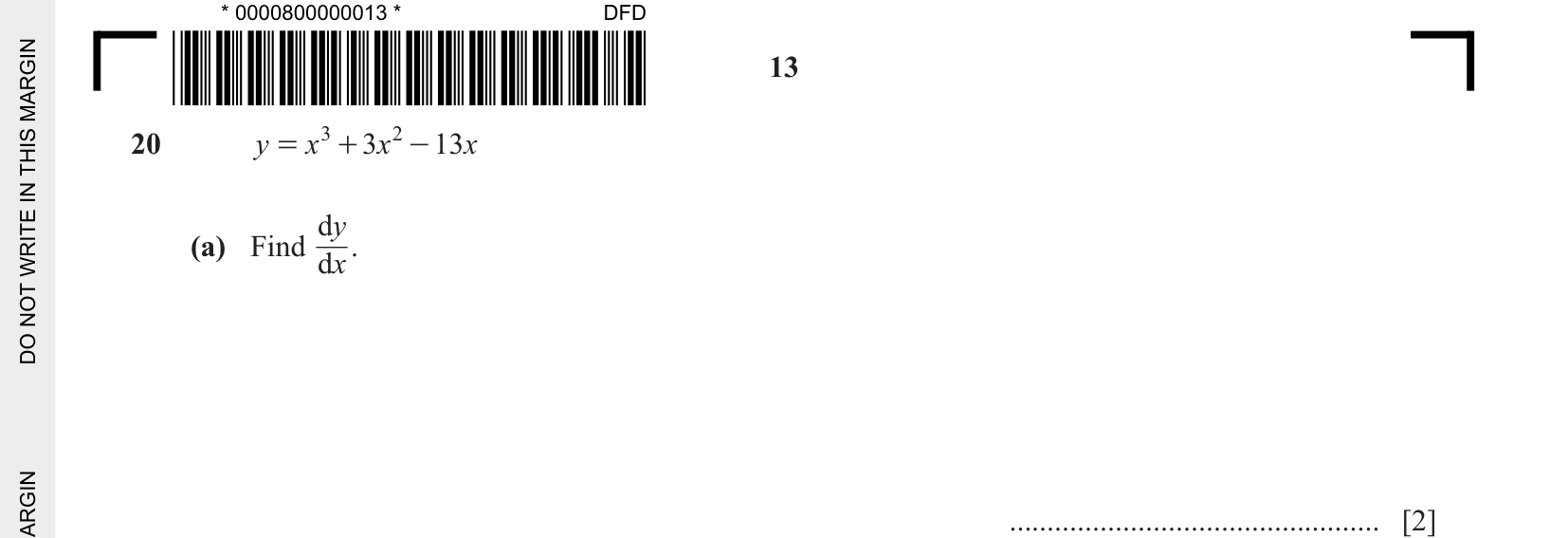
Given y = x³ + 3x² − 13x. Apply the power rule to each term: differentiate xⁿ to get nxⁿ⁻¹.
dy/dx = 3x² + 6x − 13. Term by term: x³ → 3x², 3x² → 6x, −13x → −13.
Exam Tip
The power rule (multiply by the power, reduce the power by 1) is the most tested differentiation technique at IGCSE Extended. Remember that the derivative of a constant term is 0, and the derivative of kx is simply k.
Finding a Missing Side Using Similar Triangles
Similar Triangles · [2]
Step-by-Step Solution
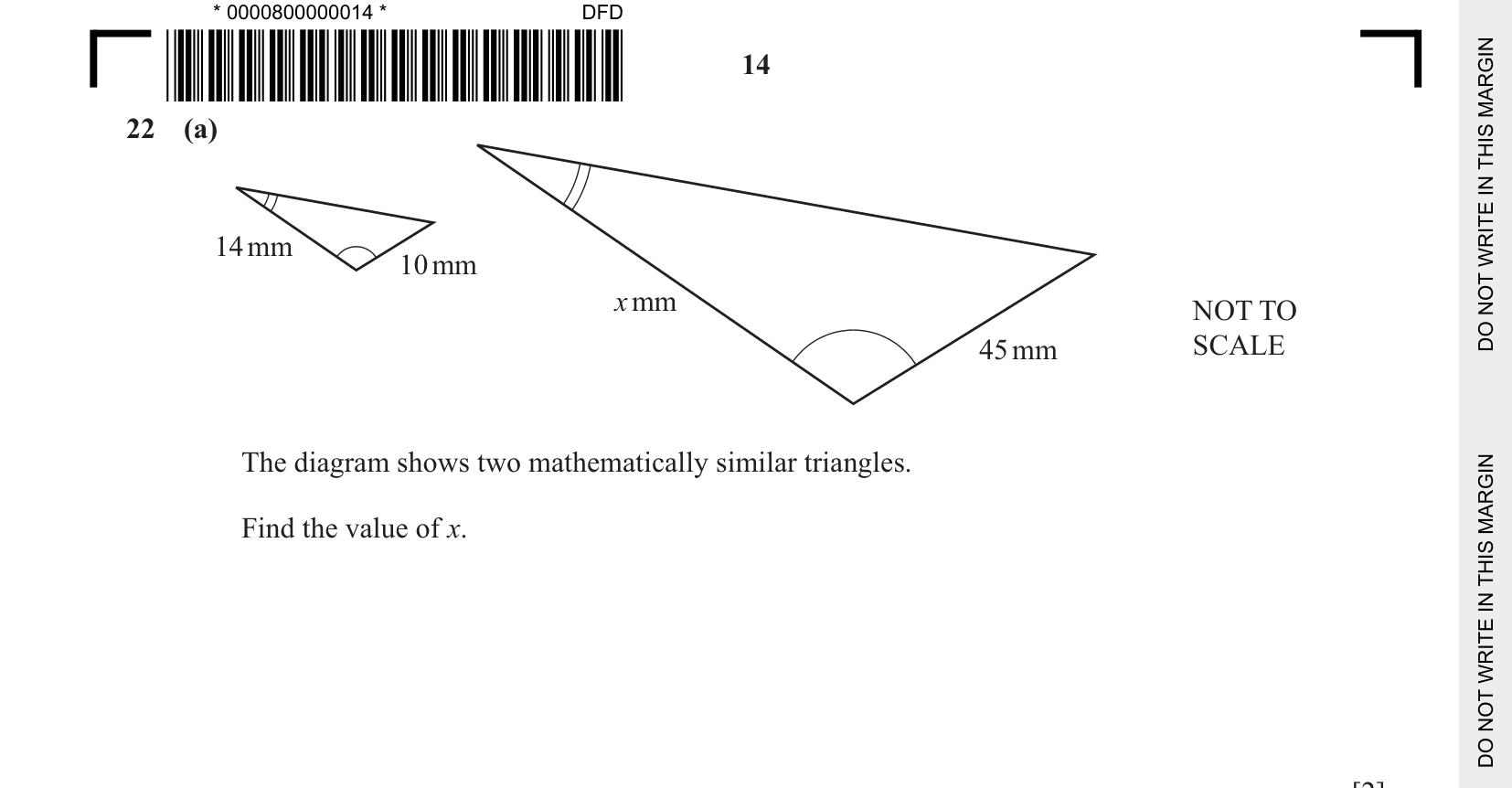
The two triangles are mathematically similar. Identify the corresponding sides using the equal angle marks. The sides of 10 mm and 45 mm are opposite the same angle (marked with a circle), so they are corresponding sides.
Scale factor = 45 / 10 = 4.5. The side of 14 mm in the small triangle corresponds to x mm in the large triangle. Therefore x = 14 × 4.5 = 63 mm.
Exam Tip
Always identify corresponding sides by matching the angles they are opposite or between. Write the scale factor as a fraction or decimal, then multiply. A common mistake is dividing instead of multiplying (or vice versa) — check that the larger triangle gives the larger answer.
Estimating the Mean from a Grouped Frequency Table
Grouped Frequency / Statistics · [4]
Step-by-Step Solution
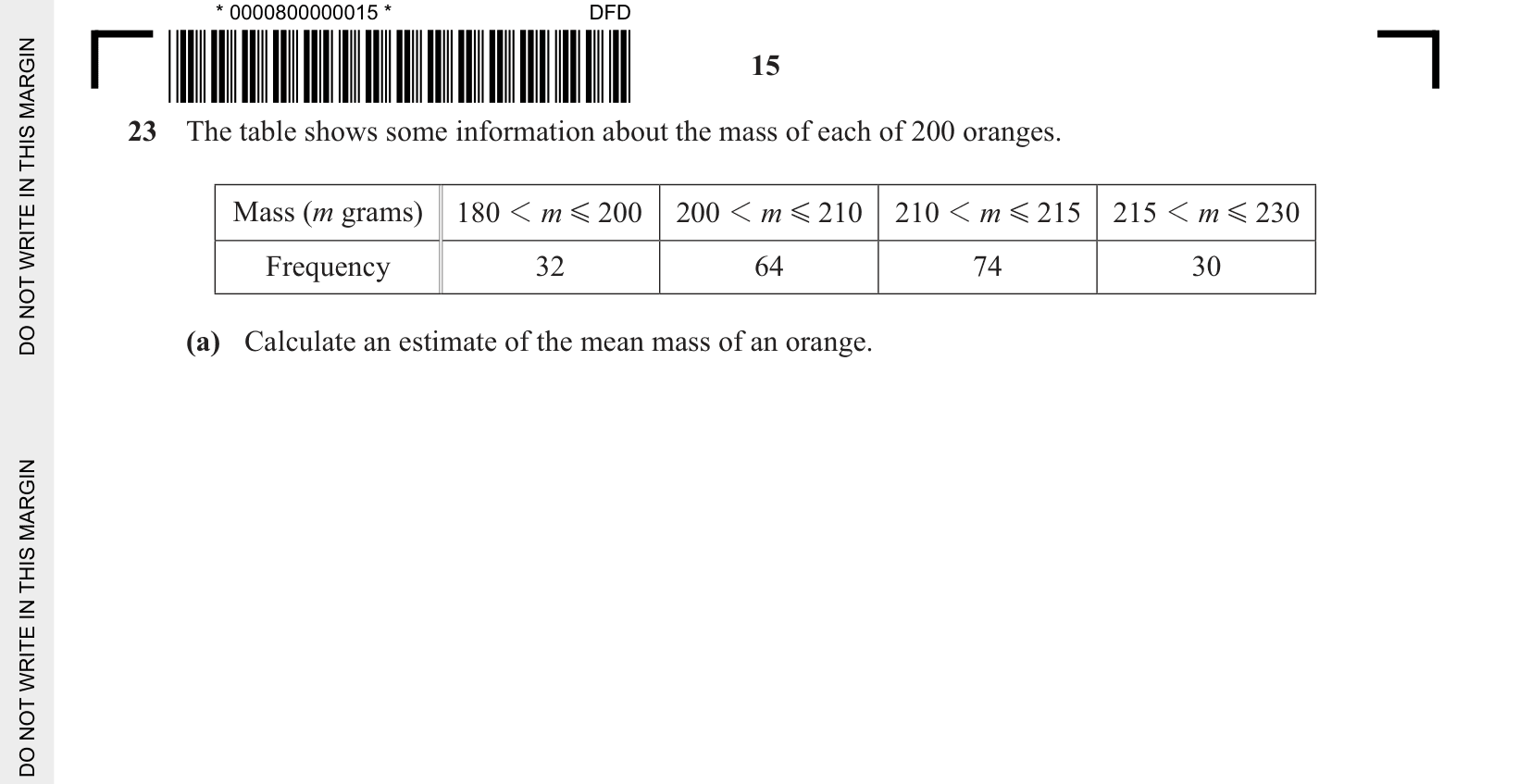
Find the midpoint of each class interval: 180 < m ≤ 200 → midpoint 190; 200 < m ≤ 210 → midpoint 205; 210 < m ≤ 215 → midpoint 212.5; 215 < m ≤ 230 → midpoint 222.5.
Multiply each midpoint by its frequency: 190 × 32 = 6080; 205 × 64 = 13120; 212.5 × 74 = 15725; 222.5 × 30 = 6675.
Sum of (midpoint × frequency) = 6080 + 13120 + 15725 + 6675 = 41600. Total frequency = 32 + 64 + 74 + 30 = 200. Estimated mean = 41600 / 200 = 208 grams.
Exam Tip
This is an "estimate" because we use midpoints — we don't know the exact values within each class. Always show your midpoints and the sum of (f × midpoint) clearly in a table. Check that your total frequency matches the number given in the question (here, 200 oranges).
3D Pythagoras in a Cuboid — Finding Edge EF
3D Pythagoras · [4]
Step-by-Step Solution
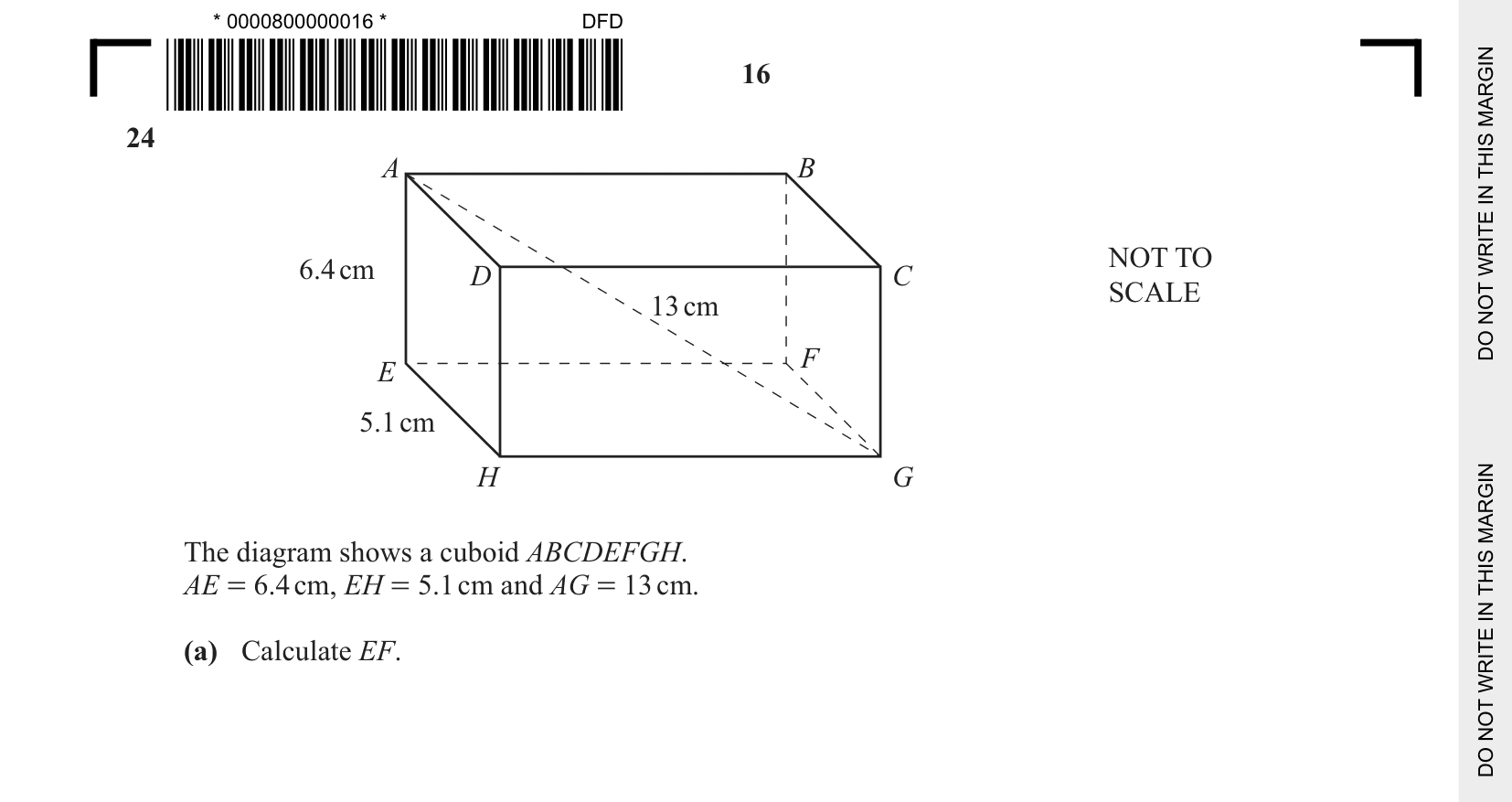
In cuboid ABCDEFGH, the space diagonal AG connects two opposite corners. The three edges meeting at E are: AE = 6.4 cm (height), EH = 5.1 cm (width), and EF = ? (depth).
The 3D Pythagoras formula for the space diagonal is: AG² = AE² + EF² + EH² (since AE, EF, and EH are three mutually perpendicular edges, and A and G are opposite vertices).
Substitute: 13² = 6.4² + EF² + 5.1². So 169 = 40.96 + EF² + 26.01. Therefore EF² = 169 − 40.96 − 26.01 = 102.03.
EF = √102.03 = 10.1 cm (to 3 significant figures).
Exam Tip
For 3D Pythagoras, the space diagonal d satisfies d² = a² + b² + c² where a, b, c are the three edge lengths. You can also solve it in two steps: first find the base diagonal (EG² = EF² + EH²), then use AG² = AE² + EG². Both methods give the same answer.
Bounds of Remaining Wire After Cutting Two Pieces
Upper and Lower Bounds · [3]
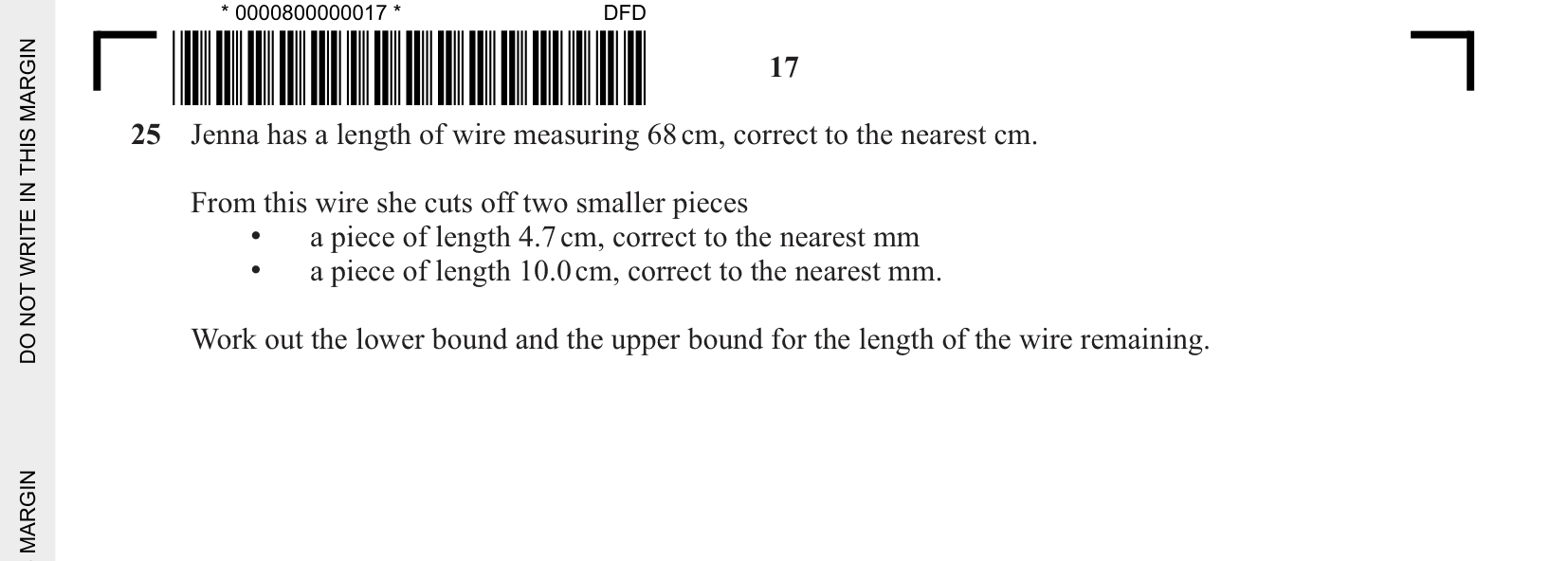
Step-by-Step Solution
Identify the bounds for each measurement. Wire = 68 cm (nearest cm): lower bound 67.5, upper bound 68.5. Piece 1 = 4.7 cm (nearest mm): lower bound 4.65, upper bound 4.75. Piece 2 = 10.0 cm (nearest mm): lower bound 9.95, upper bound 10.05.
Remaining wire = total wire − piece 1 − piece 2. For the LOWER bound of a subtraction, use the smallest possible total and the largest possible pieces: lower bound = 67.5 − 4.75 − 10.05 = 52.7 cm.
For the UPPER bound, use the largest possible total and the smallest possible pieces: upper bound = 68.5 − 4.65 − 9.95 = 53.9 cm.
Exam Tip
In bounds questions involving subtraction, remember: to minimise a result you subtract the maximum values, and to maximise it you subtract the minimum values. This is the opposite of what you do for addition. Write out all bounds first before calculating — it prevents sign errors.
Initial assessment
Find out what is costing the marks.
Twenty minutes, one to one, online. No charge, no commitment.